An Expanded Advent

This year, we at the Hancock Congregational Church are experimenting with observing an expanded Advent season: seven weeks as opposed to the typical four. While this may seem like a radical new idea, it’s actually based in historical practice.
Much of the information and background I’ve used to consider and prepare for this come from the book, What Are We Waiting For? Re-Imagining Advent for Time to Come, by William H. Petersen.The organizers of the Advent Project Seminar in the North American Academy of Liturgy, of which Petersen was the convener, which originally proposed this shift in the liturgical calendar, request that congregations testing it out commit to doing so for three years, and my plan is to honor that.
The original reasons for an expanded season are two-fold. First, for a long time now, the observance of Advent within the Church has been lost to what Petersen calls “Christmas culture.” In a world where commercial Christmas begins November 1 (or even before), by the time Advent and the new liturgical year begin at the end of November or in early December, churches often just focus on a four-week journey to Bethlehem and the manger. However, that is only one side–and arguably the less important one!-- of the Advent coin. In Petersen’s words:
The primary [focus] is beginning the new church year with a steady look at the “end times,” that is, at the goal of fulfillment of all the implications of Christ’s resurrection for humanity and, indeed, the entire creation. This is usually called the “kingdom” or the “reign of God.” That emphasis is intended to give the beginning of the annual cycle of the liturgical year an emphasis that will help Christians to engage ever more deeply in Christ’s mission of peace, justice, and the integrity of creation.
In other words, we’ve been missing the main point of Advent, and depriving ourselves of a deeply meaningful approach to the season and a new year by considering it only as a lead-in to Christmas, rather than fully its own season (like Lent is much more than a preparation for Easter).
The second reason for an expanded season offered by the Advent Project Seminar is to shift the narrative of these “end times” from the more apocalyptic and rapture-focused versions to one more authentically rooted in Scripture.
I have a third reason to consider an elongated Advent, and it is part of a larger effort to slow us down, to not only get more depth rather than just breadth of Scripture by regularly focusing on one text for an entire month or season, but also to enable us time to more fully experience the various seasons and holy rhythms of the church year. If Advent is meant to be a season of waiting, of expectation, then relegating it to the four Sundays before Christmas is entirely counter-productive, because the busyness of the weeks leading up to December 25–with special events, extra services, and recruiting additional volunteers–infiltrates the church despite our best intentions. By starting three weeks earlier, we get more time to immerse ourselves in the words, themes, and practices of Advent before the full onslaught of the “holiday season” descends after Thanksgiving.
All that being said, only a few things will change in a practical sense. We will still light the Advent wreath, only now it will have seven candles. The music and liturgy will be thematically oriented towards the lectionary-based Scripture readings as well as the guideposts of the “O Antiphons,” most recognizably laid out in the verses of “O Come, O Come, Emmanuel.” In addition, we will be intentional about holding the Sanctuary as a space for Advent, rather than Christmas, until the final week, after which we will keep Christmas until Epiphany in January.
Hopefully, with an expanded Advent, we will arrive at the celebration in Bethlehem with a greater appreciation and understanding of why we undertake this annual cycle from the birth of Jesus, to the cross and the tomb, and to the birth of the church at Pentecost.
I hope this explanation offers some insight into what we’re doing and why, and as with any experiment, patience, openness, and feedback are encouraged.
With wishes for a blessed and meaningful Advent,
Rev. Beth Simmons
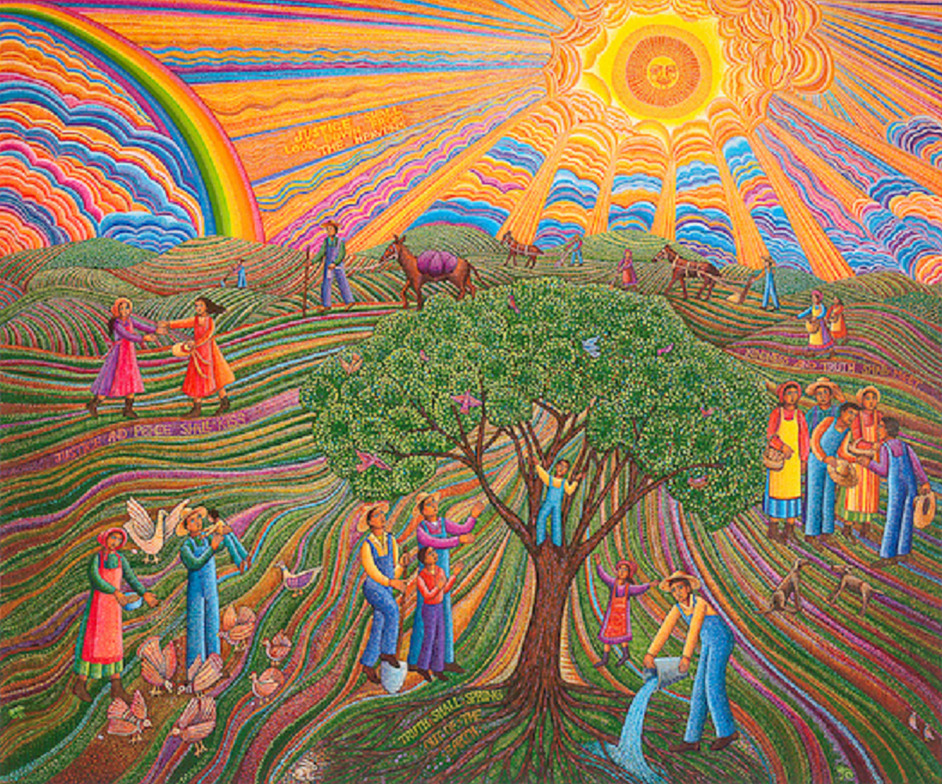
Image: Psalm 85 world of peace and justice by J. A. Swanson (Source: Eyekons Gallery)